The global challenge of Population Collapse (13Jun2023)
My investing muse
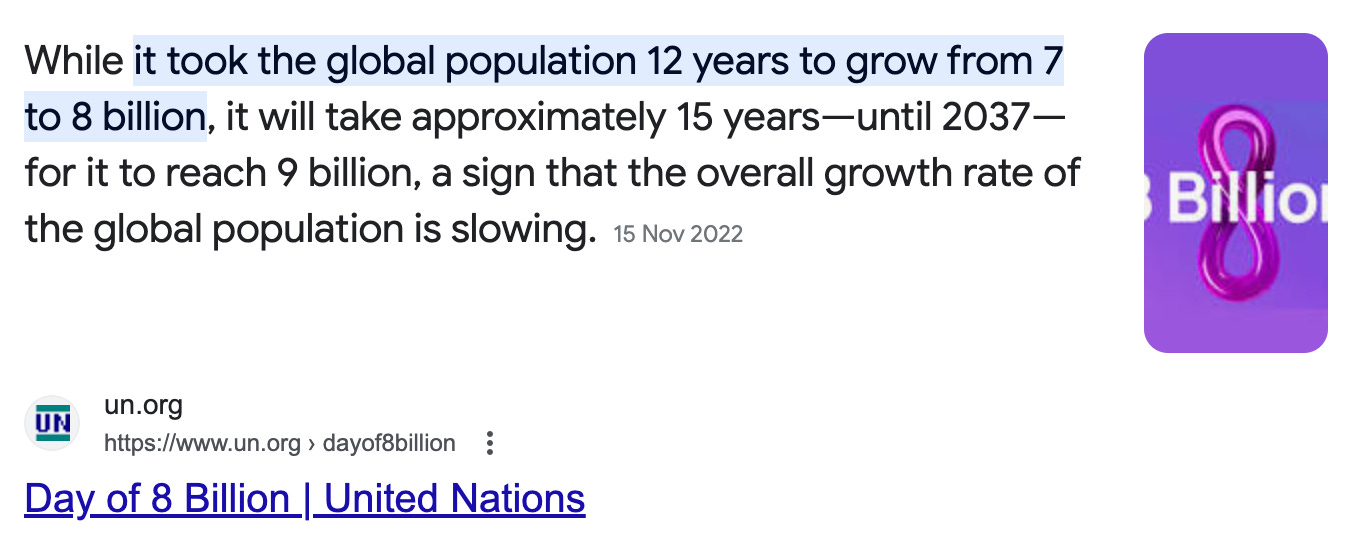
Earth has hit the 8 billion population mark recently. The below is extracted from a Nov 2022 UN post:
While it took the global population 12 years to grow from 7 to 8 billion, it will take approximately 15 years—until 2037— for it to reach 9 billion, a sign that the overall growth rate of the global population is slowing.
We are seeing more developed countries with ageing challenges, a drop in births and longer life expectancy.
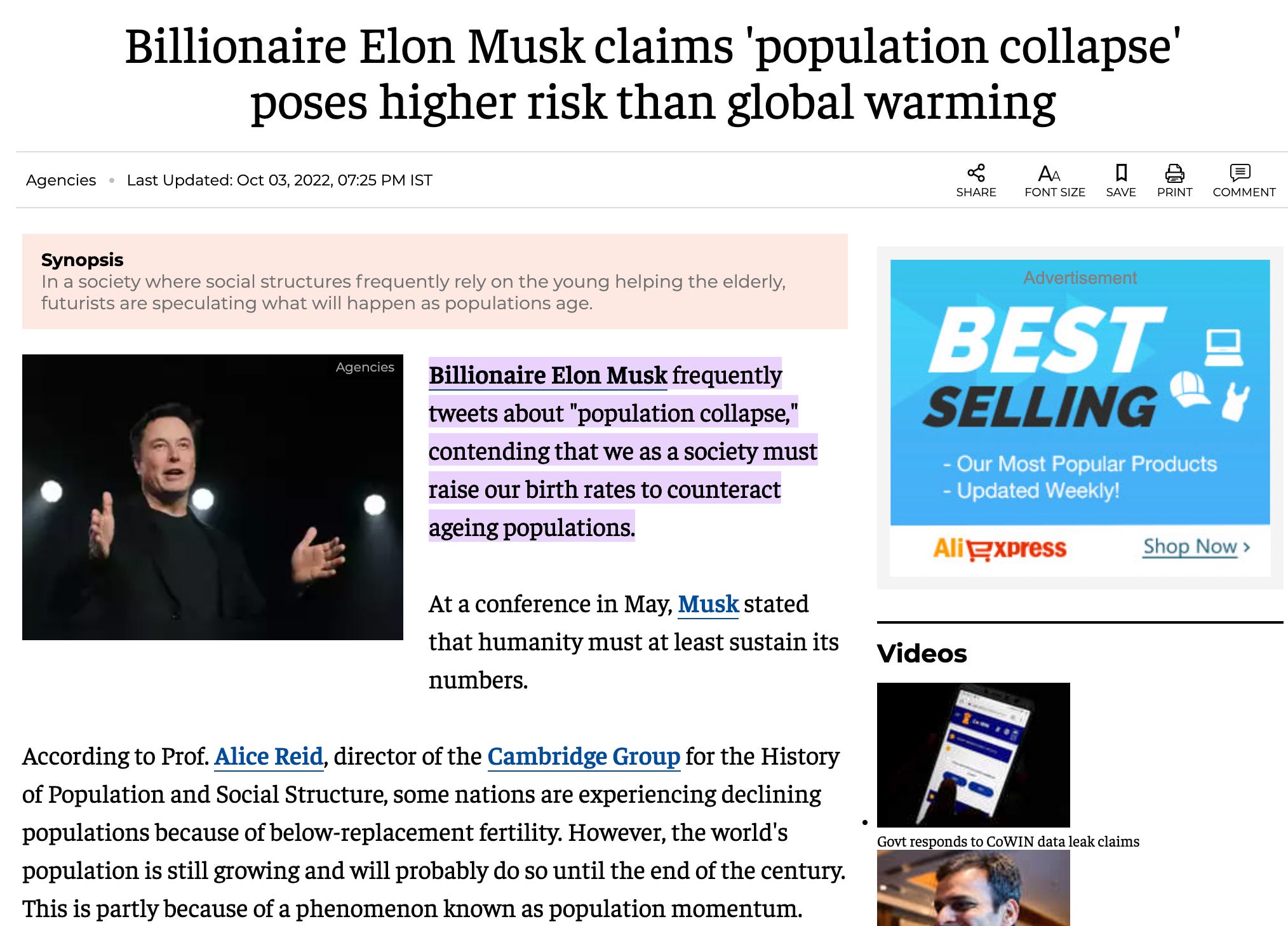
Elon Musk has been vocal about a population collapse as seen in the economic times article. While most of us are aware of “Climate Crisis”, we are probably not familiar with the risks of population collapse.
It is not just affecting the population but there are also economic impacts which can potentially bankrupt nations ~ developed countries included.
When low birth rates meet longer life expectancy, this means that we have a lesser population who will be working to support the economy. This is likely leading to the economy being supported by lesser working people. In this economy, there will be a notable pool of elderly demographics. Most of the elderly may wish to retire but some of them may continue to work out of necessity (due to costs of living) or due to “job satisfaction”.
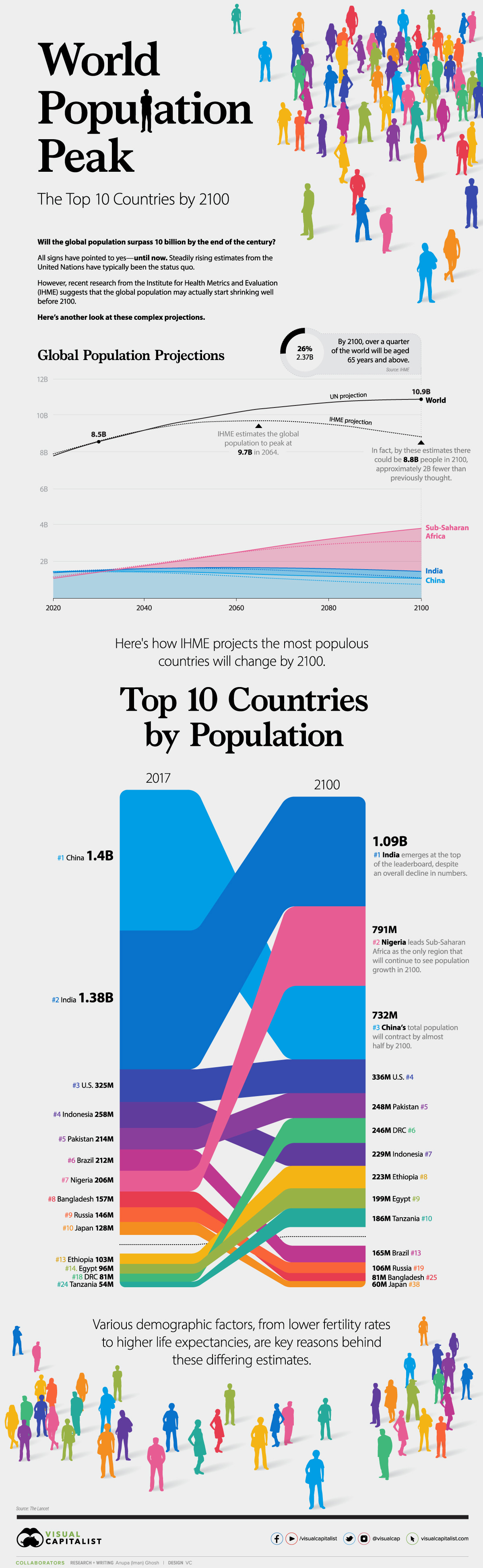
This population collapse can turn out to be a major problem. Using Japan as a reference, their population is 128M in 2017. This population is likely to decline to 60M by the year 2100. Can the Japanese (as a race) dwindle away? China could probably be overtaken by Nigeria by 2100. Doesn’t this imply that Africa could be the next potential region of growth? Thus, my long-term view of investing in China would need a review in about 10-12 years’ time.
The following research on population, birth rate and the consequence of population decline is done via Google Bard.
Birth rate
The minimal birth rate needed to avoid population decline is called replacement level fertility. The replacement level fertility is estimated to be around 2.1 children per woman for most countries. If the birth rate falls below the replacement level fertility, the population will decline over time, as there are fewer births than deaths.
The birth rate can be influenced by many factors, including cultural and social norms, economic conditions, and government policies. This has implications for economic growth, social welfare programs, and the overall age structure of the population.
Birth rate for developed countries
According to the latest data available from the World Bank, the average birth rate for high-income OECD countries (which includes many developed countries in North America, Europe, and the Asia-Pacific region) was 1.6 births per woman in 2020.
In the United States specifically, the birth rate was 1.6 births per woman in 2020. In Europe, the birth rate varies widely by country, with some countries like Spain and Italy having relatively low birth rates (around 1.2 births per woman), while other countries like France and Ireland have higher birth rates (around 1.8 births per woman).
Is the world facing a population crisis?
The world is not facing a population crisis in the sense that the population is growing too large and unsustainable. In fact, the opposite is happening: the global population is projected to peak at 9.7 billion in 2064 and then decline to 8.8 billion by 2100. This is due to a number of factors, including declining fertility rates, increasing life expectancy, and changing social norms.
While a declining population may seem like a good thing, it can also have a number of negative consequences. For example, it can lead to a shrinking workforce, a decline in economic growth, and an ageing population. It can also make it more difficult to provide for the needs of the elderly and to maintain social security and healthcare systems.
As a result, it is important to start planning for a future with a declining population. This includes policies that encourage immigration, investment in education and training, and reforms to social security and healthcare systems. It is also important to raise awareness of the challenges of population decline and to develop strategies to mitigate its negative effects.
Here are some of the potential consequences of population decline:
A shrinking workforce: A declining population means that there will be fewer people to work. This can lead to a shortage of skilled workers, which can make it difficult for businesses to operate and for the economy to grow.
A decline in economic growth: A shrinking workforce and a decline in consumer demand can lead to a decline in economic growth. This can make it difficult for governments to provide essential services and can lead to social unrest.
An ageing population: A declining population also means that there will be more older people. This can put a strain on healthcare and social security systems, as well as on families who are caring for elderly relatives.
It is important to note that the consequences of population decline will vary from country to country. Countries with a young population and a strong economy are likely to be less affected than countries with an ageing population and a weak economy. However, all countries will need to start planning for a future with a declining population.
Countries with fastest Ageing population
Here are some of the countries with the fastest ageing populations:
Japan
Italy
Germany
Spain
Portugal
Greece
Finland
Sweden
South Korea
These countries are ageing rapidly due to a number of factors, including:
- Declining birth rates
- Increasing life expectancy
- Emigration of young people
The ageing population in these countries is having a number of negative consequences, including:
A shrinking workforce
Increased pressure on healthcare and social welfare systems
A decline in economic growth
Here are some of the countries with the lowest birth rates:
Japan
Italy
Spain
Portugal
Greece
South Korea
China
Taiwan
Hong Kong
These countries have low birth rates due to a number of factors, including:
- Increasing economic development
- Increased female participation in the workforce
- The rising cost of raising children
- Changing social attitudes towards family and marriage
The low birth rates in these countries are having a number of negative consequences, including:
- A shrinking population
- A decline in economic growth
- Increased pressure on healthcare and social welfare systems
It is important to note that the ageing population and low birth rates are not just problems for developed countries. Many developing countries are also facing these challenges. In fact, the United Nations has predicted that by 2050, there will be more elderly people in the world than children under the age of 15. This will have a profound impact on societies around the world, and governments will need to find ways to adapt to this changing demographic landscape.
Why developed countries suffer more from low birth rates and ageing population
There are a number of reasons why developed countries suffer more from low birth rates and ageing populations than developing countries.
Economic development: Developed countries tend to be more economically developed than developing countries. This means that people in developed countries have higher incomes and more access to education and healthcare. As a result, people in developed countries tend to have smaller families than people in developing countries.
Female participation in the workforce: Developed countries also tend to have higher rates of female participation in the workforce than developing countries. This means that women in developed countries are more likely to work outside the home, which can make it more difficult for them to have children.
The rising cost of raising children: The cost of raising children has also risen in developed countries. This is due to a number of factors, including the rising cost of housing, education, and healthcare. As a result, people in developed countries may be less likely to have children because they can't afford to raise them.
Changing social attitudes: Social attitudes towards family and marriage have also changed in developed countries. In the past, it was more common for people to get married and have children at a young age. However, today, people are more likely to delay marriage and childbirth. This is due to a number of factors, including the increasing availability of contraception, the rise of individualism, and the increasing number of women in the workforce.
The ageing population and low birth rates are having a number of negative consequences for developed countries. These include:
A shrinking workforce: As the population ages, there will be fewer people of working age. This could lead to a decline in economic growth and a shortage of workers in certain industries.
Increased pressure on healthcare and social welfare systems: The ageing population will place a strain on healthcare and social welfare systems. This is because older people are more likely to need healthcare and social services than younger people.
A decline in economic growth: A shrinking workforce and increased pressure on healthcare and social welfare systems could lead to a decline in economic growth. This could have a negative impact on the standard of living for everyone in the country.
Governments in developed countries are working to address the challenges posed by the ageing population and low birth rates. These efforts include:
Encouraging people to have more children: Governments are offering financial incentives and other programs to encourage people to have more children.
Increasing immigration: Governments are increasing immigration to help offset the effects of the ageing population.
Reforming healthcare and social welfare systems: Governments are reforming healthcare and social welfare systems to make them more sustainable in the face of an ageing population.
The ageing population and low birth rates are complex challenges that will require a long-term commitment from governments and individuals. However, by working together, we can find ways to ensure that these challenges do not have a negative impact on our societies.


Comments
Post a Comment