Posts

Showing posts with the label bear market

How should we invest should markets turn bearish? - Indices review as of 10May2022

Image
Summary of the indices - let us look at the macro market to understand how the markets are performing. Are we entering a recession or a technical recession? Forbes defines the following as a recession ? During a recession, the economy struggles, people lose work, companies make fewer sales and the country's overall economic output declines. The point where the economy officially falls into a recession depends on a variety of factors. The business times define a technical recession as the following: A technical recession occurs when the gross domestic product (GDP) contracts on a sequential basis for 2 consecutive quarters.  What is the difference between a market correction and a bear market? Schwab defines the following for correction and bear market : The general definition of a market correction is a market decline that is more than 10%, but less than 20%. A bear market is usually defined as a decline of 20% or greater. A death cross (using a 1D chart) takes place when the 5...
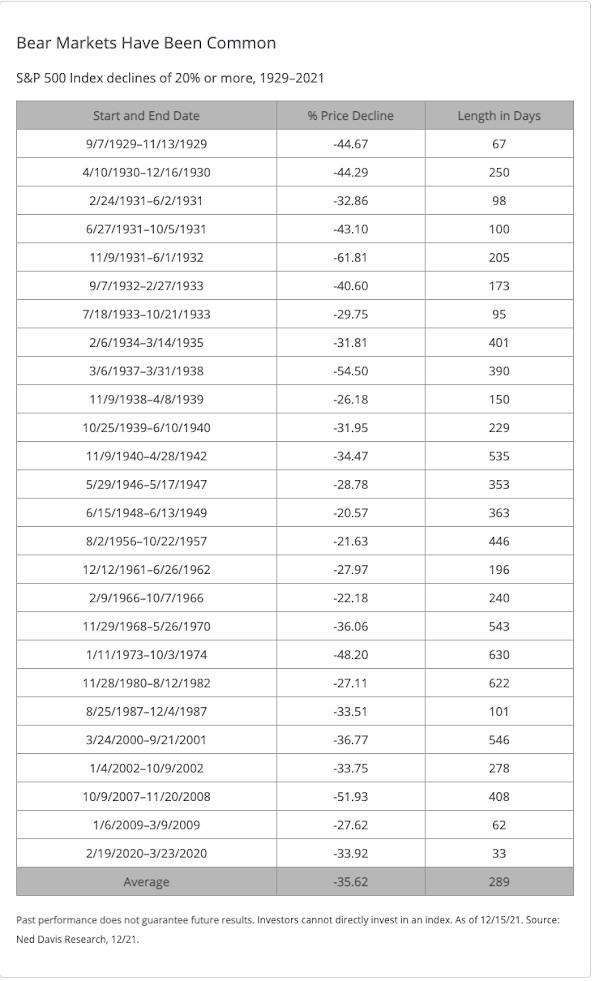
10 Things You Should Know About Bear Markets (Hartford Funds)

Image
I have stumbled upon this great article "10 things you should know about bear markets". Source of the article: https://www.hartfordfunds.com/practice-management/client-conversations/bear-markets.html Excellent observations about the market by Hartford Funds.  Watch for 20% : Market cycles are measured from peak to trough, so a stock index officially reaches bear territory when the closing price drops at least 20% from its most recent high (whereas a correction is a drop of 10%-19.9%). A new bull market begins when the closing price gains 20% from its low. Stocks lose 36% on average in a bear market . By contrast, stocks gain 114% on average during a bull market . Bear markets are normal. There have been 26 bear markets in the S&P 500 Index since 1928. However, there have also been 27 bull markets—and stocks have risen significantly over the long term. Bear markets tend to be short-lived . The average length of a bear market is 289 days, or about 9.6 months. That’s signi...